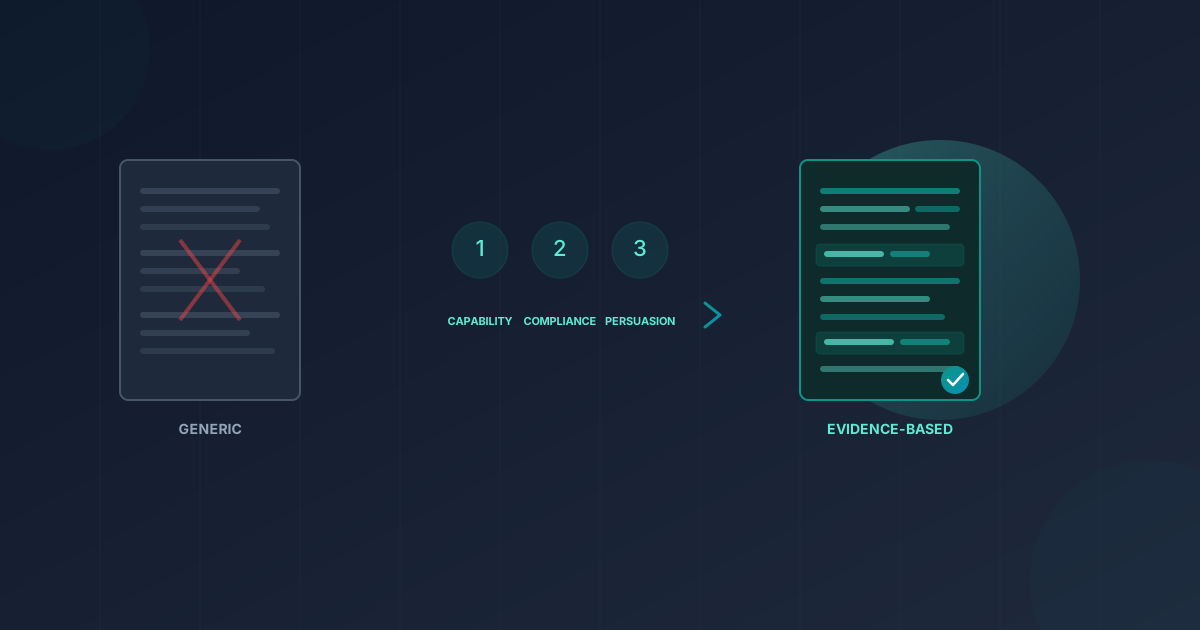


A technical look at how we improved proposal writing quality and rebuilt the scoring system from first principles — shifting from 'did you fill in the blanks' to 'will this win.'

The biggest impact on proposal scores doesn't come from better templates or formatting. It comes from giving Craxy AI the right source material and telling it exactly how to use it.
We recently shipped a set of changes to how Craxy generates proposal content and evaluates readiness. Here's what changed and why it matters.
When you select specific documents (resumes, past performance, capability statements), those now override general Knowledge Base content. Craxy AI extracts actual names, dates, contract values, and metrics from your selected docs first. KB fills gaps only where selected docs don't cover.
During RFP analysis, Craxy AI identifies 2-4 win themes — the differentiators that set you apart. These are then woven naturally throughout every section, reinforced as a recurring thread the way a human proposal strategist would. The result: a cohesive narrative where your competitive advantages show up exactly where evaluators are looking.
If the RFP says Technical Approach is worth 40% and Management is worth 20%, Craxy AI allocates depth proportionally. Sections tied to high-weight criteria get more detail, stronger evidence, and tighter alignment to scoring language. No more treating every section equally.
Each section receives context from dependency-mapped prior sections. The cost proposal knows the methodology from the technical approach. The executive summary pulls proof points from every completed section. Dependency mapping follows real proposal logic: cost depends on technical + team + management, not just 'the previous section.'
Every paragraph follows a Claim-Proof-Benefit structure: make a claim, back it with specific proof (names, numbers, dates), connect it to a client benefit. At least one concrete data point per paragraph. On the flip side, 20+ filler phrases ("cutting-edge," "holistic approach," "leverage synergies") are banned outright, paragraphs are capped at 2-3 sentences, and fake names are detected and replaced automatically.
When you type "budget must not exceed $97K, use AWS, assign Sarah as PM," we parse that into structured constraints (budget, technology, team) and inject them as hard rules Craxy AI must follow. Not suggestions it might ignore.
Cost and pricing sections now receive parallel-analyzed data: estimated contract value ranges, market rate breakdowns, budget context from the RFP, and critical pricing factors. Previously, cost sections were written with the same generic context as every other section.
Writing better content is only half the equation. You also need to know whether what was generated actually holds up. So we added an automatic validation step that runs immediately after every section is generated.
As soon as content finishes generating, Craxy AI checks it against four criteria:
Results appear in a validation bar directly above the editor — a score, critical issues, and warnings, all visible before you start editing. No extra clicks, no separate review step. Generate, validate, fix. All in one place.
The difference isn't "better writing." It's that Craxy AI now has access to the right source material and is instructed to mine it for specifics instead of generating plausible-sounding generalities.
Our team brings extensive experience and a proven track record in delivering innovative, cutting-edge solutions. We leverage our holistic approach to ensure seamless project delivery that exceeds client expectations.
Our team completed 14 similar highway bridge inspections for VDOT between 2021-2024, each delivered within 3% of the original budget. On the Route 29 project, we identified structural deficiencies 6 weeks ahead of the scheduled assessment, saving the agency an estimated $240K in emergency repair costs.
One paragraph is filler. The other wins contracts.
The old system gave proposals a score out of 100 across four categories: completeness, RFP alignment, quality, and checklist. The problem was simple—a proposal could score 90 and still lose because the score didn't measure what evaluators actually care about.
A proposal with perfect formatting, all sections filled, and zero spelling issues would score high. But if the company lacked a required certification or the writing was generic boilerplate, it would be eliminated in round one. We needed to separate things you cannot fix by rewriting from things you can fix, and tell you which is which.
Instead of one score, we now evaluate proposals through three distinct lenses, in the same order an evaluator would.
Can this company actually deliver the work?
We cross-reference your Knowledge Base documents (past performance, certifications, team bios) against RFP requirements. If the RFP requires CMMI Level 3 and the KB doesn't mention it, that's a capability gap. No amount of better writing fixes it. These surface as critical issues with a link to update the Knowledge Base.
Did the proposal respond to every requirement?
We map each extracted RFP requirement to outline sections and check if it's addressed in the written content. Missing a required form, skipping an evaluation criterion, or leaving a section thin are fixable gaps. Each issue links directly to the section editor.
Will this beat a compliant competitor?
We evaluate writing quality: are claims backed by evidence? Are outcomes quantified? Is the language client-focused or self-focused? These are improvement suggestions, not blockers.
Verdict logic: If Layer 1 has critical issues, the proposal is flagged as needing attention regardless of how well the rest is written. If only Layer 2 has issues, it's at risk. If only Layer 3, it's ready with suggestions.
Every issue includes why it matters to the evaluator, a concrete suggestion (not "improve this" but "add your CMMI Level 3 certification from your Knowledge Base"), and a direct link to the exact section or KB page where you fix it. Issues are sorted by what costs you the most points first. Fix, come back, recheck.
From "did you fill in all the blanks" to "will this win."
Win themes extracted from your RFP and woven through every section. Content weighted to match evaluation criteria. Every claim backed by proof. Automatic validation the moment content is generated. And a readiness system that thinks like an evaluator, not a spell-checker.
These changes are live for all Craxy AI users. Upload an RFP, generate content, and run a readiness check to see the three-layer evaluation in action.
Start your free trial and experience AI-powered content generation with built-in readiness scoring.
Start Free Trial