


Right now, somewhere on a government procurement site, there is an RFP that your company is perfectly positioned to win.
You will never see it.
Not because you are not looking. You are. Your BD team checks SAM.gov every morning. Someone scans a few state portals. Maybe you have Google alerts set up. But there are over a thousand procurement sites across 50 countries, and your team has eight hours in a day.
The math does not work. It never has.
The Sourcing Problem Nobody Talks About
The proposal industry has spent the last decade obsessing over the writing phase. AI tools that draft sections. Templates that speed up compliance matrices. Collaboration platforms that keep reviewers in sync.
All of that matters. But it assumes you found the opportunity in the first place.
Here is the uncomfortable truth: most BD teams operate on a fraction of available opportunities. They monitor a handful of sites, rely on tip-offs from partners, and hope the right RFPs land in their inbox. The ones they miss? Those go to competitors who happened to be looking at the right portal on the right day.
This is not a strategy problem. It is a coverage problem. And until recently, there was no good solution. You could hire more analysts, but salaries add up fast. You could subscribe to aggregator databases, but they are expensive and still require someone to sift through results. You could build internal scrapers, but maintaining them is a full-time engineering job.
So most teams accept the gap. They pursue what they find and try not to think about what they are missing.
What an AI Agent Does Differently
An AI sourcing agent does not check portals on a schedule. It monitors them continuously. It does not get tired, forget to check a site, or take vacation. It does not need coffee at 2 PM.
Here is how it works inside Craxy AI.
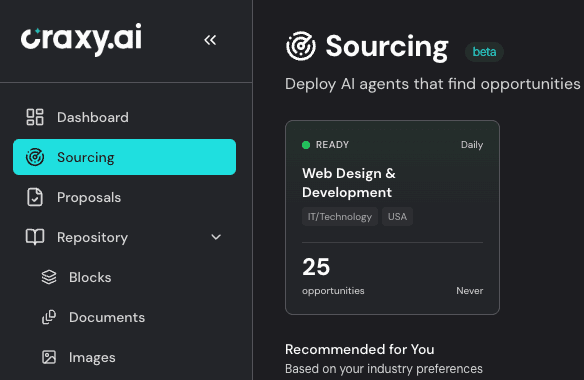
You tell the agent what you are looking for. Your industries, your keywords, the regions you serve. You connect your knowledge base — past proposals, capability statements, company descriptions — so the agent understands not just what you want, but what you can actually deliver.
Then you deploy it.
The agent fans out across procurement sites and starts scanning. When it finds something relevant, it does not just drop a link in your inbox. It reads the full solicitation. It extracts the requirements, the deadlines, the evaluation criteria. Then it scores the opportunity against your company profile and tells you whether this is a GO, a CAUTION, or a NO-GO.
By the time you see the result, the analysis is already done. You are not starting from "is this worth reading?" You are starting from "should we bid on this?"
70+ Categories. One Agent.
Government procurement covers everything. IT modernization contracts sit next to road paving bids, which sit next to healthcare staffing RFQs. The categories are enormous and deeply varied.
Craxy AI agents scan across all of them:
Technology and IT: Web development, software applications, mobile apps, AI and machine learning, networking, data analytics, cybersecurity, computer supplies.
Healthcare and Medical: Medical services, pharmaceutical, billing, case management.
Construction and Facilities: General construction, painting, plumbing, electrical, HVAC, janitorial, real estate.
Professional Services: Consulting, staffing, legal, HR, marketing, translation, writing, call center, background checks.
Financial: Auditing, banking, insurance, billing, debt collection, asset management.
Defense and Government: Military, fire and safety, federal, quality control.
Transportation: Ground vehicles, marine, aircraft, railway.
Environmental and Energy: Water and sewage, waste management, recycling, utilities.
Education and Social: Training programs, social services, food and catering.
And dozens more. You pick the categories that match your business, and the agent ignores everything else. No noise. No irrelevant results cluttering your pipeline.
Scoring: The Part That Actually Saves Time
Finding opportunities is only half the problem. The other half is figuring out which ones are worth pursuing.
Every BD team has been burned by this. An RFP looks promising from the title. You download the 200-page document. Your team spends hours reading through it. Then someone realizes the incumbent has a five-year relationship with the agency, or the requirements demand a certification you do not have, or the budget is a third of what the work actually costs.
That is a Tuesday afternoon you are not getting back.
AI scoring eliminates that waste. When the agent finds an opportunity, it does not just match keywords. It reads the actual solicitation and evaluates it against your company profile — your past performance, your certifications, your team size, your geographic coverage.
A high score means this is genuinely in your wheelhouse. A low score means there are red flags. A caution score means it could go either way and deserves a closer look.
Your team stops spending time on opportunities that were never real. They start spending time on the ones that are.
From Finding to Winning: The Full Loop
Here is what makes agentic sourcing different from a fancy search engine: it connects directly to the rest of your proposal workflow.
When an agent surfaces a high-scoring opportunity, you can move it into your proposal pipeline with one click. The RFP is already uploaded. The requirements are already extracted. The analysis is already started.
Your team picks up the work at the outline stage, not the "download and read" stage. The hours you used to spend on discovery and initial analysis are gone. Your proposal writers start writing on day one instead of day three.
For teams that run multiple proposals simultaneously, this compression matters. A three-day head start on a 14-day deadline is not a minor efficiency gain. It is the difference between a polished submission and a rushed one.
Deploy Once, Run Forever
You set up an agent in about five minutes. Pick your industries, choose your location, add a few keywords if you want to narrow the focus. Connect your knowledge base documents so the scoring engine has context. Set a schedule — daily, weekly, whatever fits your pace.
Then forget about it.
The agent runs on its own. Results show up in your workspace. You review them when you have time. Star the ones you want to pursue. Archive the ones you do not. Export to CSV if your team tracks opportunities in a spreadsheet.
You can run up to five agents simultaneously. One for IT contracts in the US. One for healthcare in Canada. One for construction across Europe. Each agent is independent, with its own keywords, categories, and scoring criteria.
Your coverage just went from "the three sites we remember to check" to "every relevant procurement site on the planet."
The Real Cost of Not Looking
There is a number that never shows up in your CRM: the deals you did not know existed.
You cannot calculate opportunity cost on opportunities you never saw. You cannot run a win-loss analysis on bids you never submitted. The revenue is invisible, which makes it easy to ignore.
But your competitors are not ignoring it. The firms winning contracts you have never heard of are not smarter than you. They are not writing better proposals. They are simply finding more opportunities.
When your coverage is broader, your pipeline is fuller. When your pipeline is fuller, you can be selective. When you are selective, your win rate goes up. When your win rate goes up, your past performance improves. When your past performance improves, you win even more.
The sourcing advantage compounds. And it starts with seeing what others miss.
Stop Missing Winnable Deals
Your next contract is already posted somewhere. The question is whether you will find it before your competitor does.
Deploy an AI sourcing agent and find out.