


Every proposal professional knows the feeling.
You're reviewing a promising RFP when another lands in your inbox. Same deadline. Both winnable. Both worth pursuing. But your team can only do one well, so you make the call: pursue this one, let that one go.
That decision has a name: opportunity cost. And for decades, it's been the invisible tax on every business development team.
The Hidden Price of Every "Yes"
Opportunity cost isn't just economic theory. It's the revenue you didn't capture because your team was stretched thin. It's the client relationship that never started because you couldn't respond in time. It's the market share that went to a competitor who simply showed up when you couldn't.
The math is brutal. If your team can handle five proposals per month and six good opportunities arrive, one gets left behind. Not because it wasn't worth pursuing—but because humans have limits.
Traditional solutions haven't solved this. Hiring more people helps, but good proposal writers are expensive and hard to find. Templates speed things up, but they produce generic responses that evaluators see through immediately. Outsourcing works for some, but you lose control and institutional knowledge.
So teams accept the trade-off. They get strategic about which opportunities to pursue and which to abandon. They build elaborate scoring matrices to justify saying no to winnable deals.
And every quarter, they wonder about the revenue left on the table.
The Bottleneck Was Never Strategy
Here's what proposal teams rarely admit: the go/no-go decision often isn't really about strategy. It's about capacity.
When you dig into why a team passed on an opportunity, the reasons often sound strategic—"not the right fit," "low probability of win," "outside our core competency." But scratch the surface and you'll find a different truth: we didn't have the bandwidth.
The RFP looked good. The client was a fit. The requirements aligned with your capabilities. But your senior writer was already on two other responses. Your subject matter experts were tapped out. Your compliance team was drowning in another proposal's requirements matrix.
So you called it a no-go and moved on.
This isn't a strategy problem. It's a throughput problem. And for years, the only solution was to accept it.
What Changes When Time Isn't the Constraint
Imagine your proposal process worked differently.
A new RFP arrives. Within minutes—not hours or days—you have a complete analysis: requirements mapped, win themes identified, compliance matrix drafted, and a realistic assessment of your competitive position.
Your team reviews the analysis and makes a genuine strategic decision. Not "can we do this?" but "should we do this?" The capacity question is off the table.
If the answer is yes, the first draft starts generating immediately. Not a template stuffed with placeholders, but actual content informed by your past wins, your differentiators, and the specific requirements of this opportunity.
Your experts spend their time reviewing and refining, not staring at blank pages. Your writers focus on strategy and persuasion, not compliance formatting. Your reviewers catch issues while there's still time to fix them.
This isn't a fantasy. It's what happens when AI handles the parts of proposal development that consume time but don't require human judgment.
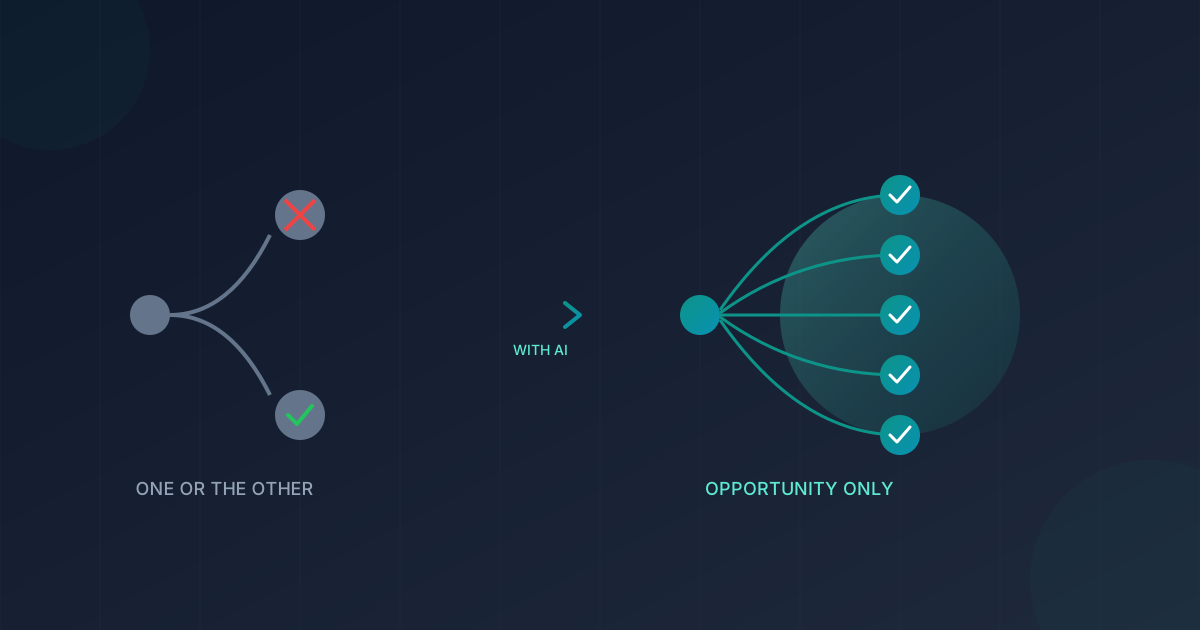
From Opportunity Cost to Opportunity Only
The shift isn't just about doing more. It's about changing how you think about opportunities entirely.
In the old model, every opportunity came with an asterisk: *if we have capacity. That asterisk forced conservative thinking. When saying yes to one thing meant saying no to another, teams naturally became risk-averse. They chased sure things and avoided stretch opportunities.
But when capacity isn't the constraint, the calculus changes.
That mid-sized opportunity that would have been a distraction? Now it's worth a shot—the marginal effort is low. That ambitious opportunity you would have passed on because of timeline? Now it's feasible—the analysis and first draft happen fast enough to meet the deadline.
The question shifts from "can we afford to pursue this?" to "is there any reason not to?"
This is what we mean by "opportunity only." Not that every opportunity is worth pursuing—some genuinely aren't. But every opportunity deserves genuine strategic consideration, not automatic rejection because your team is already underwater.
The Compounding Effect
Here's what isn't immediately obvious: the benefits compound.
When you pursue more opportunities, you win more deals. When you win more deals, you build more past performance. When you have more past performance, your future proposals get stronger. When your proposals get stronger, your win rate increases. When your win rate increases, you can be more selective about which opportunities deserve your attention.
It's a virtuous cycle—but you can't start it if you're stuck in the old model of trade-offs and tough choices.
The teams that figure this out first don't just win more. They pull ahead of competitors still making go/no-go decisions based on bandwidth instead of strategy.
The Real Strategic Advantage
We built Craxy AI because we watched proposal teams make these painful trade-offs. Smart people, working hard, forced to pass on good opportunities because the math didn't work.
The technology isn't magic. It's just fast. It analyzes RFPs in minutes. It generates compliant first drafts in hours instead of days. It handles the mechanical work that was eating up your team's time.
What your team does with that time is up to you. But for the first time, the constraint isn't how many proposals you can write. It's how many you want to win.
That's the end of opportunity cost. That's opportunity only.
Ready to Stop Leaving Revenue on the Table?
Every opportunity you pass on goes to someone else. With AI-powered proposal development, you can pursue more opportunities without burning out your team.
See how Craxy AI can transform your proposal process.